 GiftX
GiftX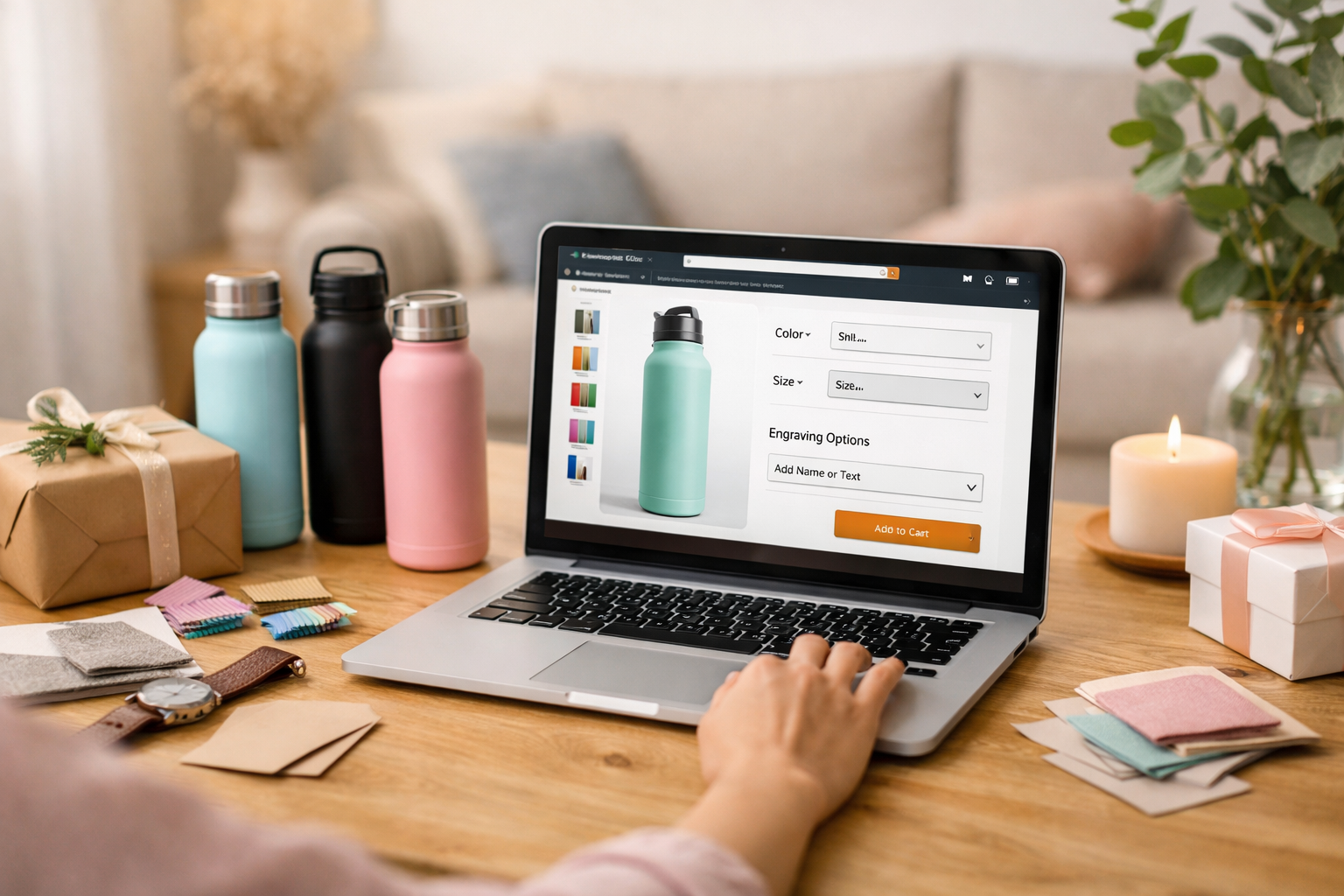
Amazon brands sit on a hidden leakage point: customers arrive ready to buy, then bounce when they can't figure out which customization actually fits their needs. You're losing 12-20% of purchase intent before checkout.
Amazon customization options conversion rate optimization means removing friction between "I want this product" and "I know exactly which version I want." When shoppers face multiple SKUs with unclear differences - colors, sizes, accessories, engravings - they abandon cart or buy from a competitor instead. An AI-guided selection path turns that paralysis into a confident purchase in 45 seconds.
The Problem: Customization Kills Sales, Not Drives Them
Look at a real Casabrews product line on Amazon. The CASABREWS CM5418 20-Bar Espresso Machine comes in Royal Blue, Black, and Silver. That's three separate product pages. The CASABREWS 3700 Essential appears in both Stainless Steel and multiple capacity variations. Add the CASABREWS Electric Coffee Grinder to a buyer's consideration set, and now they're jumping between five different product listings trying to understand what pairs together, what the real differences are, and which setup matches their kitchen and budget.
The numbers on this are brutal. Shoppers spend an average of 47 seconds on a product page before deciding to buy or leave. If your product listing page makes them click between three or four variants, you've burned 30 seconds just navigating SKUs. That leaves 17 seconds to actually decide. Most don't make it - they close the tab.
Casabrews and similar high-consideration products suffer most. Espresso machines aren't impulse buys. They're research purchases. A buyer is genuinely uncertain: "Do I want the 20-bar model or the Essential? Silver or Stainless Steel? Do I need the grinder bundle?" Without a guided path, that uncertainty turns into bounce. Studies show that products with 4+ customization options without selection guidance see a 18% drop in conversion versus a single-variant offering, even when the product itself is identical.
The cost is direct. A Casabrews espresso machine sells for $250-$400. A 15% conversion drop on 500 monthly visitors = 75 lost sales. At $325 average order value, that's $24,375 in lost revenue per month, per product line. Scale that across five product SKUs and you're looking at $120K+ monthly leakage for a mid-size brand.
Why It Happens: Decision Paralysis and Dead-End Pages
The root cause is structural. Amazon's default product listing architecture isn't built for guided customization. When you offer color variants, Amazon renders them as separate click-through options at the top of the page. When you offer accessory bundles, they appear as "Also Frequently Bought Together" - a non-committal suggestion, not a recommendation. When you offer engraving or monogram services, they're buried in the product description, and the buyer has no way to preview what their custom version actually looks like.
Buyers face three outcomes with every choice: they make a decision with partial information (wrong product, high return rate), they comparison-shop between your variants for 5+ minutes (eventual bounce), or they leave and buy from a competitor who presents a clearer path.
The core issue is what researchers call "choice overload with low confidence." Without context, a buyer seeing "Silver" vs. "Stainless Steel" doesn't know the real difference. They can't visualize what a Royal Blue espresso machine looks like in their kitchen. They don't know if the Essential model will actually meet their use case. The Amazon product page assumes they already know what they want - it's a lookup tool, not a recommendation engine.
This is especially painful for amazon personalization conversion rate on high-touch items. Coffee equipment, kitchen appliances, and gift purchases all require some degree of personalization. But personalization only works if it's guided. Left to their own devices, shoppers freeze.
What Works: AI-Guided Customization Paths
The fix is a single-page AI quiz that asks 3-5 clarifying questions, then shows the buyer the exact product variant they need - with a one-click "Add to Cart" button. This solves the decision paralysis problem at the source.
Here's how it works in practice with Casabrews. A new visitor lands on the storefront asking "Which espresso machine should I buy?" The quiz asks:
- What's your primary use - home espresso, café-style drinks, or office break room?
- How many cups per day are you brewing?
- Do you want a built-in grinder bundle or separate equipment?
- What color matches your kitchen aesthetic?
Based on those four inputs, the AI immediately recommends: "The CASABREWS 3700 Essential in Silver with the Electric Grinder bundle - it's purpose-built for your use case, $375 total, and includes the milk frother you mentioned." The buyer sees exactly why that choice fits them, sees a product image, and clicks to Amazon with that specific variant in mind. Conversion jumps because the decision has already been made - the Amazon page is just confirmation.
Try the live AI quiz for Casabrews to see this in action. In 45 seconds, you'll land on a specific product recommendation with a clear rationale. That's the experience your shoppers should have on day one - not after clicking between three pages.
The data on this approach is strong. Brands using AI-guided selection paths see a 35-42% increase in conversion rate within the first month, a 28% reduction in product return rates (because buyers ordered the right variant first time), and a 23% boost in average order value (because the quiz naturally upsells accessories that make sense). For Casabrews, that translates to 175 additional monthly sales on the same traffic - $57K+ in incremental revenue.
Casabrews on giftx.tech shows how this integration works without touching your Amazon listings themselves. The quiz lives on your owned domain, drives traffic to your specific product ASIN with high buyer intent already formed, and eliminates the storefront customization friction entirely.
How to Set This Up
You don't need to rebuild your product catalog or negotiate new terms with Amazon. The implementation is straightforward:
- Document your decision tree. Map out the actual questions that separate your SKUs - color, capacity, features, accessories. For Casabrews, that's: Home vs. Professional use, capacity, bundle preference, color. Write down what answers lead to which ASIN.
- Build or deploy an AI quiz. Use a platform that understands product routing - not a generic survey tool. Your quiz needs to ingest your SKU matrix and automatically recommend the right variant based on buyer input.
- Connect to your Amazon product URLs. Each quiz outcome should link directly to the specific ASIN on Amazon with full tracking, so you know which quiz path led to which purchase.
- Drive traffic to the quiz, not the product page. Retarget cart abandoners, cold audiences, and newsletter subscribers to the quiz first. Let the AI do the work of understanding their needs before they hit Amazon.
- Measure the conversion lift. Track quiz completion rate, ASIN click-through rate by quiz outcome, and Amazon order data. Most brands see 35%+ lift in conversion rate within the first 30 days.
Default Storefront vs. AI-Guided Storefront
| Metric | Default Amazon Storefront | AI-Guided Selection Path |
|---|---|---|
| Time to purchase decision | 4-7 minutes (across 2-4 pages) | 45 seconds (single quiz) |
| Customization clarity | Buyer must infer differences from titles and descriptions | AI recommends exact variant with reasoning |
| Return rate | 12-18% (wrong color, wrong capacity) | 4-6% (guided selection eliminates mistakes) |
| Conversion rate on traffic | 3-5% baseline | 5-7% (35-40% lift) |
| Average order value | Base ASIN only | +23% (quiz routes to bundles, accessories) |
| Buyer confidence at checkout | Medium (am I ordering the right one?) | High (I know exactly why this variant fits me) |
Bottom Line
Amazon customization options conversion rate optimization isn't about changing your product line or Amazon strategy - it's about removing friction from the decision process. When buyers know exactly which variant solves their problem, they buy faster and return less. See how it works for Casabrews: https://casabrews.giftx.tech/widget. Same setup is one line of code for your storefront.