Secret Santa With Exclusions: How to Keep Couples From Drawing Each Other
How to keep partners, siblings and roommates from drawing each other in Secret Santa, from a paper chain to a quiet swap after an online draw.
Short answer: a Secret Santa name picker with exclusions keeps certain people, usually couples, from drawing each other. If your picker draws fully at random, you get the same result with a simple house rule: anyone who draws their partner quietly trades names with one volunteer before shopping. For a small family with several couples, a paper chain set up in advance works even better.
Exclusions sound like a technical problem, but they are mostly a social one. Partners already buy for each other, siblings in the same house can see each other's packages arrive, and roommates tend to guess. The goal is not a perfect algorithm. The goal is a draw that feels fair and a fix that nobody has to explain at dinner.
Why groups want exclusions in the first place
Most requests fall into four groups. Knowing which one you have helps you pick the lightest fix.
- Couples. The classic case. They exchange gifts anyway, so a Secret Santa pick between them feels wasted.
- Last year's pairs. Families who play every year do not want the same giver and receiver twice in a row.
- Same household. Kids in one home, or roommates, find it hard to hide a purchase from each other.
- Parent and young child. A six-year-old cannot shop for Dad without Dad's help, which ruins the surprise.
If only one or two of these apply, a swap rule is enough. If all four apply in a group of ten, plan the chain on paper before you draw anything.
How likely is it that partners draw each other
In a big office exchange it is rare. Each person has many possible names, so the chance of landing your own partner is small, and most couples laugh it off when it happens. In a family of six with two couples, it is much more common. Expect it to happen in some years, and set the rule before the draw so nobody feels singled out.
The mistake groups make is waiting until it happens. Someone says "I got my wife" out loud, and now everyone knows two of the pairs. Agree on the fix in the invite, in one line, and the problem stays private.
Option one: a random Secret Santa name picker plus a quiet swap
This is the method that works with any random Secret Santa name picker, including GiftX Secret Santa. It keeps the draw simple and moves the exclusion into one private conversation.
- Put the rule in the invite: "If you draw your partner or someone from your own home, message the organizer before you shop."
- The organizer runs the draw as normal.
- Anyone with an excluded pick messages the organizer privately.
- The organizer finds one volunteer who is happy to trade, without telling anyone why.
- The two people trade names directly. Each now buys for the other's original pick.
- Both check that the new pick is not also excluded for them. If it is, the organizer asks a second volunteer.
The trade touches only two pairs, so everyone else's draw stays exactly as it was. Choose a volunteer who is good at keeping quiet, because they now know one extra name.
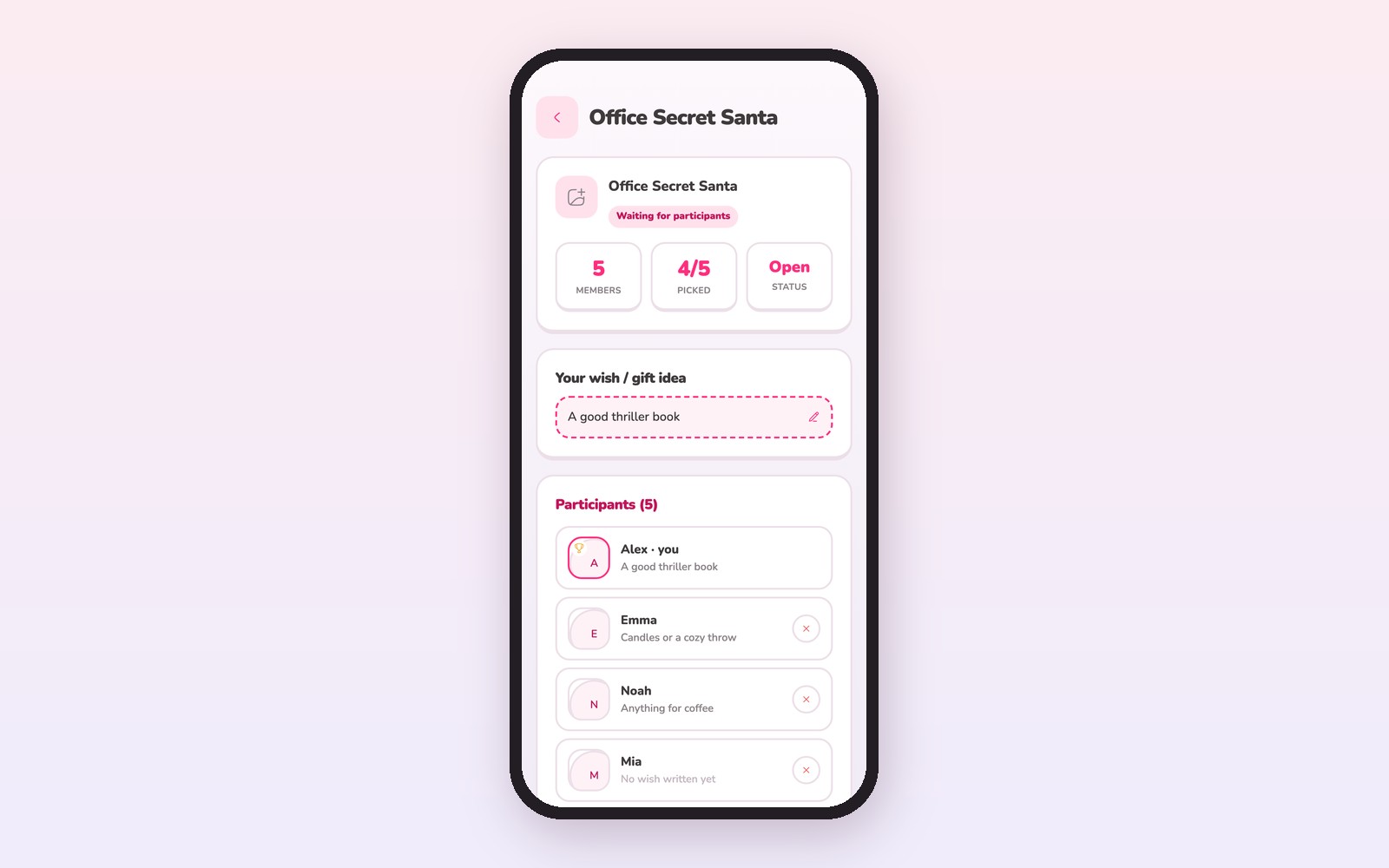
In GiftX, the organizer creates the group with a name, the gift budget and an optional cover photo, then shares one invite link. People join in one tap, the organizer starts the draw once at least two have joined, and each person sees only the name they drew. Because the organizer does not see the other pairs, they can still play, and they only learn about the pairs that people choose to report.
Option two: the paper chain for small families
For six to twelve people with several couples, a hand-built chain avoids exclusions completely. It takes ten minutes and one trusted person who is not playing, or who is fine knowing the whole chain.
- Write every name on a card.
- Shuffle the cards and lay them in a circle.
- Check every neighbor pair. If two partners sit next to each other, move one of them two places along.
- Each person buys for the person on their left.
- Text each player only their own pick.
A circle guarantees nobody draws themselves and that the whole group forms one loop, which makes the reveal fun when you open gifts in order. The weak point is that the person who built it knows everything. That is why this method suits a grandparent who sits out or a parent running a kids' exchange.
Option three: split into two exchanges
Sometimes the cleanest exclusion is separate groups. Families often run one exchange for adults and one for kids. Big friend groups can split by city if half the group ships gifts. Each smaller group draws on its own, so couples who sit in different groups cannot meet.
| Situation | Split | Why it helps |
|---|---|---|
| Couples plus kids | Adults group and kids group | Parents never draw their own child |
| Two households of siblings | Mix households, then draw | Same-home picks become rare |
| Friends in two cities | Local group and shipping group | Shipping stays optional |
| Large office with teams | Draw across the whole office | Close teammates rarely pair |
In GiftX, each exchange is its own group with its own link and budget, so two smaller exchanges are as easy to set up as one big one.
Option four: decide that it does not matter
Some groups skip exclusions on purpose. If partners draw each other, they get a free pass to buy something they would have bought anyway, and the budget keeps it modest. This works best in large offices, where it is rare, and in relaxed friend groups where nobody minds. Say so in the invite, so a couple who draws each other does not feel they broke a rule.
Fixes for tricky cases
Real exchanges produce odd combinations. Here is how to handle the ones that come up most.
- Two couples drew each other. Have the two people from different couples trade. One trade fixes both pairs.
- No volunteer wants to trade. The organizer can start a fresh exchange and everyone joins the new link. Do this before anyone shops.
- Someone keeps last year's pick. Treat it like a partner draw: a quiet trade with a volunteer.
- A parent drew their own small child. Trade with an aunt, uncle or grandparent who can shop without the child watching.
- A late joiner arrives after the draw. One volunteer buys for the newcomer, and the newcomer buys for that volunteer's original pick.
The fresh exchange is the reset button. Use it once, early, and only if trades cannot solve the problem. People get suspicious when a draw happens three times.
What to write in the invite
One short paragraph prevents almost every awkward moment. Copy and edit this one:
"Names are drawn at random. If you get your partner or someone you live with, message me privately and I will set up a quiet trade. Please do not announce who you got."
Pair it with the budget, the date and the link, and add a line asking people to add a wish before the draw. For more ready-made text, see our Secret Santa invitation wording, and for the rest of the setup, our free Secret Santa generator guide walks through the draw step by step.
Frequently asked questions
Can a Secret Santa name picker exclude couples automatically?
Some pickers let you mark pairs that should never match. Others, including GiftX, draw fully at random. With a random picker, set a house rule: anyone who draws their partner messages the organizer, who arranges a quiet trade with a volunteer. It takes two minutes, touches only two pairs and keeps everyone else's draw unchanged.
How do you swap names without revealing the whole draw?
Only three people need to know: the two who trade and the organizer who connects them. The person with the excluded pick tells the organizer, the organizer asks a trusted volunteer, and the two trade their picks privately. Nobody else hears about it, and the organizer still only knows two pairs.
What if the swap creates a new problem?
Check before anyone shops. If the volunteer's original pick is someone the first person also should not have, ask a second volunteer instead. In a group of eight or more this is rarely needed. If every option fails, the organizer starts a fresh exchange and the group joins a new link.
Should couples just be allowed to draw each other?
In large groups, many couples are fine with it and treat it as a joke. In small families it can feel like a wasted pick, since they already exchange gifts. Ask the couples before you draw. The answer decides whether you need a swap rule at all.
Keep reading
For a families-only plan, read family Secret Santa across ages and households. Need the core rules first? See how Secret Santa works. Shopping on a small budget? Try Secret Santa gifts under $20, or browse all our gift exchange guides.[1]